 Ultimate guide
Best Practices for Student Parent Reunification
Last Updated: November 5, 2026
Quick Summary
The best practices for student parent reunification begin with a written plan that names a primary and backup for each role, documents primary and secondary reunification sites, and sets release verification steps before an emergency. Practice the full release process through staged drills, then hold an after-action review within a week and write the fixes into the plan.
- Assign a named primary and backup for student release, identity verification, parent check-in, traffic, and communication.
- Put every reunification site agreement in writing, including the facility contact and who unlocks the building.
- Verify identity against the authorized guardian list and confirm any custody restrictions before releasing a student.
- Sequence drills as tabletop, then staff-only functional, then full drill with volunteer parents.
- Hold the after-action review within a week and assign each fix an owner and a date.
Table of Contents
- Why Student-Parent Reunification Deserves a Written Plan
- Building Your School Reunification Plan Template
- Choosing and Equipping the Reunification Site
- Student Release Verification Procedures That Hold Up
- Running a School Reunification Drill That Actually Tests the Plan
- Reunification Management Tools for Schools
- Preparing Your District to Reunite Families With Confidence
- Frequently Asked Questions
Why Student-Parent Reunification Deserves a Written Plan
The best practices for student parent reunification all start in the same place: a written plan that exists before anyone needs it.
Most districts already have a crisis response binder. Fewer have a reunification plan staff have read, practiced, and stress-tested.
During a real event, the school safety team manages student accountability, parent notification, traffic, and identity verification at once, often with limited staff and unreliable connectivity.
The gaps most school plans leave open
A common mistake is treating reunification as a dismissal procedure with extra steps. Reunification involves release documentation, authorized guardian checks, and site logistics a normal dismissal never touches.
The gaps we see most often:
- No named backup for each role. The person who owns student release is out sick, and no one knows who steps in.
- No written site agreement. The off-site location was chosen verbally years ago and never confirmed with the facility.
- Emergency contact information that lives in one system nobody can reach offline.
Each looks small until the day it isn't. A flexible plan addresses them in writing, with names, not job titles alone.
Building Your School Reunification Plan Template
A school reunification plan template is a structured document that captures roles, sites, release procedures, communication steps, and drill schedules in one place. The template matters less than what it forces you to decide in advance.
Free resources exist. The Standard Reunification Method gives schools a no-cost framework for planning and carrying out reunification, and the K-12 Standard Reunification Method Toolkit supports district safety teams through planning and practice.
What every template must capture
At minimum, your template should document:
- Roles by function, with a named primary and backup for each: student release, identity verification, parent check-in, traffic management, and communication.
- Primary and secondary reunification sites, with a written agreement for each.
- Release documentation and the exact steps for confirming a student's identity before handoff.
- Emergency contact information sources and how staff access them if the network is down.
- Communication plan: who notifies parents and guardians, through which channels, and in what order.
- Drill schedule with dates, participants, and who observes and evaluates.
- After-action review process so each exercise produces changes to the plan.
If a section of your template has no owner, it has no plan.
Ready-to-adapt family communication templates
Most templates stop at "notify parents." The gap is the actual message. Draft these four in advance so staff are not composing them under pressure:
- Initial alert: what happened, that students are accounted for or being accounted for, and that reunification instructions are coming. Keep it short and avoid speculation about cause.
- Reunification instructions: the site address, which entrance to use, what identification to bring, and the expected wait. State clearly that students will only be released to authorized adults.
- Location change: a plain statement that the site has changed, the new address, and a reminder of the identification requirement.
Write each message in plain language and prepare translations for the languages your families actually speak. A message a parent cannot read is not communication.
Accessibility, language access, and trauma-informed provisions
These belong in the template body, not an appendix. Build in:
- Interpreters on call or on site, and a documented way to request one at the check-in table.
- Accessible transportation and facilities, step-free routes, accessible restrooms, and a plan for students and guardians with mobility needs.
- Accommodations for students and guardians with disabilities, including a quiet space and staff assigned to support them.
Plans often name a counselor for trauma support but never say where the private space is or who staffs it. Name both.
Watch out: treating accessibility and language access as a post-incident concern rather than a template field is how districts discover, mid-event, that the interpreter list lives on someone's desk.
Choosing and Equipping the Reunification Site
Site selection is where reunification plans quietly succeed or fail. The right reunification site is close enough to reach quickly, far enough from the incident to be safe, and large enough to hold your school population plus waiting parents and guardians without traffic backing onto a main road.
Site selection and facility capacity
Work through these criteria before you sign anything:
- Facility capacity that comfortably holds students, staff, and arriving families in separate zones.
- Access control with a limited number of entry points you can staff.
- Traffic management that keeps parent vehicles from blocking emergency vehicle access.
Put the agreement in writing. A verbal arrangement with a neighboring church or community center is not a plan; it is a hope. Confirm the facility contact, the hours it is available, and who unlocks the building.
Watch out: choosing a site because it is nearby without checking parking and traffic flow is one of the most common planning errors.
Student Release Verification Procedures That Hold Up
Student release verification procedures are the steps staff follow to confirm that the adult in front of them is authorized to collect a specific child. Strong procedures rely on identity verification against release documentation, not on recognition.
The sequence that holds up under pressure:
- Parent or guardian arrives at the check-in point and provides identification.
- Staff match the adult against the student's authorized guardian list.
- Staff confirm any custody restrictions on file.
- A runner brings the student to the release area.
- Staff record the release: who collected the student, the time, and the staff member who verified.
- The student and adult exit through a separate exit from the entry point.
Custody restrictions and authorized guardians
Custody situations change constantly, and a plan that cannot absorb those changes creates liability for the district. Build a process for updating authorized guardian lists at the start of each term and whenever a court order arrives.
Emergency contact information should list more than one contact per student, with relationship and phone number, reachable by the people running the release table.
Running a School Reunification Drill That Actually Tests the Plan
A school reunification drill is a practice exercise that walks students, staff, and volunteers through the full release process, from parent arrival to student handoff. Most districts drill evacuation.
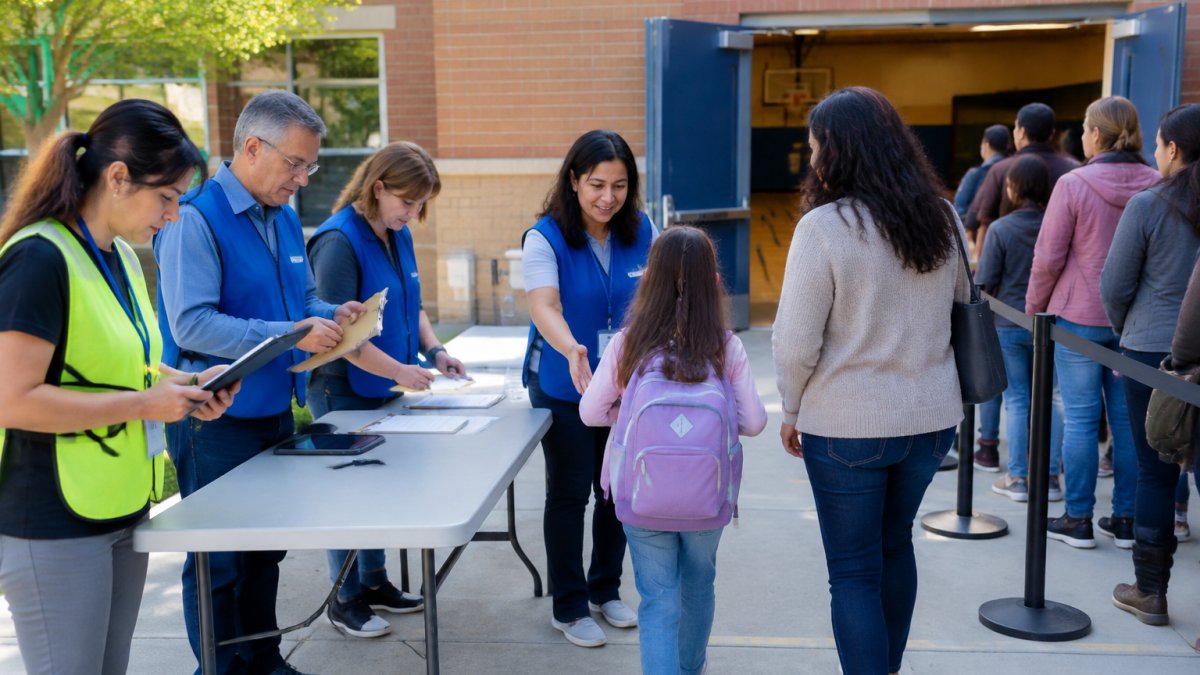
Run the drill in stages. Start with a tabletop exercise where the safety team talks through a scenario. Then run a functional drill with staff only, then a full drill with volunteer parents playing arriving guardians.
Measures that tell you whether the plan actually works
A drill that ends with "that went well" teaches nothing. Build your exercise around a small set of measures you can compare from one drill to the next:
- Time to account for all students, from the start of the event to the moment every student is confirmed accounted for at the reunification site.
- Time from first parent arrival to first student release, and the median time per release once the line is moving.
- Verification accuracy, the share of releases completed without a lookup escalation, and the number of adults who arrived without acceptable identification.
Assign an observer to each station with a simple tally sheet. A common pattern is that the parent check-in table, not the student release area, becomes the choke point, because identity verification takes longer than planners expect when several hundred adults arrive within minutes.
After-action review and plan updates
Hold the after-action review within a week, while memories are fresh. Walk through the timeline against your measures, name the specific fixes, and assign each an owner and a date.
Watch out: running a full-scale drill with real parents before staff have practiced the release sequence themselves usually produces chaos that teaches the wrong lessons, sequence the tabletop and staff-only functional drill first.
Contingencies the drill should force you to confront
Use the exercise to rehearse the scenarios that break otherwise solid plans:
- Power or network outage at the reunification site, forcing a paper fallback for check-in and release.
- A second reunification site opening because the first fills or becomes unavailable.
- Custody restrictions that surface at the release table and require a hold while staff confirm authorization.
Rehearsing these once is worth more than rehearsing the easy scenario five times.
Reunification Management Tools for Schools
Reunification management tools for schools are platforms that hold student and guardian information, support identity verification at the release point, and help staff reach emergency contacts during an event. They replace spreadsheets and paper lists with something staff can use under pressure.
For a broader look at what these systems change in practice, see our guide to the benefits of digital reunification software in 2026. Districts that want to see how the organization-facing side works can explore how reUNITEme™ supports schools, venues, and emergency teams.
| Tool or Resource | Type | Best For | Cost |
|---|---|---|---|
| Standard Reunification Method | Free framework | Districts starting from scratch | Free |
| K-12 SRM Toolkit | Planning and practice toolkit | District safety teams | Not stated |
| School Reunification Plan Template | Fillable workbook | Documenting procedures | Free |
| reUNITEme™ | Private information-sharing platform | Schools and districts managing contacts and release | Pricing on request |
Data privacy and accessibility questions to ask
Before you adopt any platform, ask:
- Who controls sharing permissions, and can a family revoke access?
- Where is data stored, and what happens to it after an incident?
- Does the system work when connectivity is limited at the reunification site?
If a vendor cannot answer the fallback question clearly, that is your answer. Every digital tool needs a paper backup, and every plan needs a version that runs without electricity.
Preparing Your District to Reunite Families With Confidence
Readiness comes down to repetition and specificity. For district-level groundwork, our emergency preparedness guide for school districts walks through the wider planning picture.
Accessibility and language access belong in the plan, not an appendix.
When your district is ready to move from a document to a working system, talk with reUNITEme™ about safer gatherings and a practical response plan built around your schools and your families.
The hardest part of reunification is not the plan.
Frequently Asked Questions
What steps should schools follow to reunite students with parents after an emergency?
Schools should move students to a designated reunification site, account for every student, and set up a parent check-in line separate from the student holding area. Staff verify each adult's identity and authorization, then a runner brings the child to the release point. Student release verification procedures should require a signature and a matching record before any child leaves. Clear communication with parents about where to go and what to bring keeps the line moving and reduces confusion at the site.
How should schools verify an adult's identity and authorization before releasing a student?
Ask for government-issued photo identification and compare it to the emergency contact record, not to a memory of the parent. Confirm the adult is listed as an authorized guardian or has documented permission, and check for custody restrictions before release. Record the name, time, and who received the child. Student release verification procedures work best when the same steps apply to everyone, including staff who recognize the parent, because exceptions are where mistakes happen.
How often should schools practice a school reunification drill?
Run at least one full drill each school year, and walk through tabletop versions more often with the safety team. A drill should test the whole chain: parent notification, site setup, student accountability, release verification, and traffic flow. Invite law enforcement and first responders to observe. After each school reunification drill, hold an after-action review and update the written plan with what failed, not just what worked.
What should a school reunification plan template include?
A usable school reunification plan template covers primary and backup reunification sites with written agreements, roles assigned by function with backups named, student accountability steps, release verification, parent communication messages, accessibility and language access, and a drill schedule. It should also name who authorizes the plan to activate and how the district safety team coordinates with law enforcement. Templates are a starting point; each school must adapt sites and procedures to its own building and families.
How can schools handle custody restrictions during student-parent reunification?
Keep custody documentation current and flag restricted contacts in the student information system so the release team sees it before a crisis. During reunification, verify against that record rather than relying on staff memory or a parent's assurance. When a dispute arises, pause the release and route it to the administrator working with law enforcement. Reunification management tools for schools help most when they store these restrictions in a form staff can check quickly under pressure.
Should schools announce the reunification site before a crisis?
Tell families in advance that the district has designated reunification sites and explain how they will be notified, but do not publish which site will be used for a specific incident. Communication plans should include pre-scripted messages, multiple channels such as emergency alerts, text, and the district website, and translated versions. During an event, send location and timing instructions only through official channels so rumors do not send parents to the wrong place.