 ultimate-guide
Emergency Preparedness for School Districts 2026 Guide
Table of Contents
- Why Emergency Preparedness for School Districts Looks Different in 2026
- Building a School Emergency Operations Plan That Staff Actually Use
- Your School Emergency Preparedness Checklist, Step by Step
- How a School Emergency Communication Plan Reaches Every Family
- The School Reunification Plan: Getting Students Back to Families Safely
- Drills, Training and Staff Roles That Build Real Readiness
- A Practical 2026 Districtwide Implementation Timeline
- Conclusion: Preparedness Is a Connection, Not a Binder
- Frequently Asked Questions
Last Updated: October 14, 2026
Why Emergency Preparedness for School Districts Looks Different in 2026
Emergency preparedness for school districts in 2026 means planning, training, and coordinating with local partners so every school can protect students, communicate with families, and reunify children with caregivers. This guide from reUNITEme™ covers the plans, drills, and reunification systems that make that possible.
The work has changed. Districts now plan for cascading events: a cyber incident that disables phone systems during a severe weather day, or a power outage mid-evacuation. Landlines and a paper binder no longer carry you through.
The throughline: preparedness is not a document you file. It is a connection you build before you need it.
Building a School Emergency Operations Plan That Staff Actually Use
A school emergency operations plan is the district's core document for prevention, protection, mitigation, response, and recovery. The best plans are short enough for a substitute teacher to follow under pressure.
Core Elements Every District Plan Needs
Every district plan should include:
- District and school emergency teams with named roles and backups
- Threat assessment and hazard identification for each campus
- Response procedures for evacuation, lockdown, shelter-in-place, and reunification
From Hazard Identification to Corrective Actions
Hazard identification starts with a safety audit: walk each site, note exit routes, and flag anything that slows a response. Then close the loop. After every drill or real event, log corrective actions with an owner and a due date. A plan that never gets updated is a plan staff quietly stop trusting.
Your School Emergency Preparedness Checklist, Step by Step
A school emergency preparedness checklist turns a binder into a routine. Use these steps, then adapt them to each school.
Before the School Year Starts
- Review and update the emergency operations plan with your district and school emergency teams.
- Confirm staff roles, backups, and training assignments.
- Verify emergency contacts for every student, including custody and guardianship notes.
- Inspect safety equipment, exit routes, and assembly areas at each site.
- Coordinate with local emergency services and law enforcement before the first bell.
During the Year: Drills, Reviews and Updates
- Run emergency drills on a schedule, including developmentally appropriate drills for younger students.
- Debrief each exercise and record corrective actions.
- Review notification procedures and test backup channels.
- Update floor plans and emergency contacts as enrollment changes.
- Revisit the plan each semester and after any real incident.
| Phase | Key Action | Frequency |
|---|---|---|
| Before school year | Plan review, staff roles, contact verification | Annually |
| Fall term | Evacuation and lockdown drills | Per district schedule |
| Winter term | Reunification exercise, notification test | Once per term |
| Spring term | Full plan review, corrective actions closed | Annually |
How a School Emergency Communication Plan Reaches Every Family
A school emergency communication plan defines who says what, to whom, and through which channel. Reach matters more than polish: a perfect message that never arrives helps no one.
Notification Procedures and Backup Channels
Build at least three channels: mass notification, a website or social post, and a staff phone tree. If your primary system shares a network with your phones, a cyber incident can take both down at once. Test backups on a schedule, not just at setup.
Inclusive Planning for Students With Disabilities
Accessibility planning belongs inside the main plan, not a separate document. Note which students need mobility, sensory, or communication support during evacuation, assign specific staff, and cover students with limited English and those who cannot self-evacuate.
The School Reunification Plan: Getting Students Back to Families Safely
A school reunification plan is the written procedure for moving students from an assembly area back to verified caregivers after an incident. It is the part families feel most and districts rehearse least.
Assembly Areas, Accountability and Reunification Roles
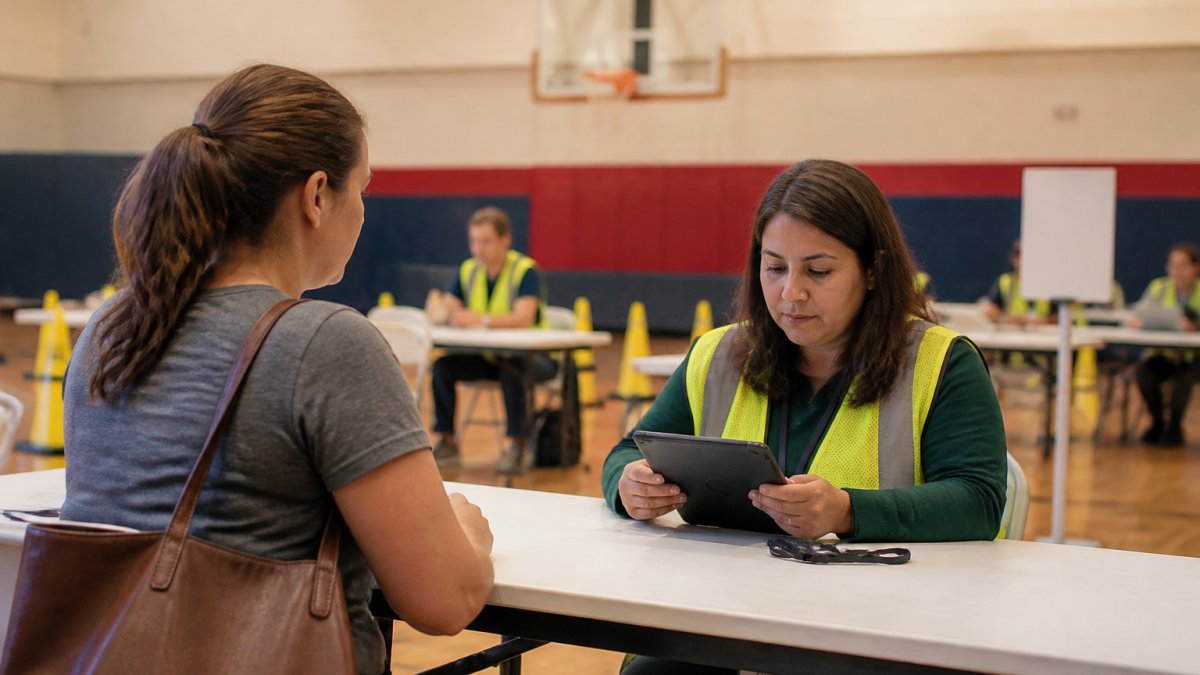
Pick assembly areas far enough from the building and large enough to hold students and arriving families separately. Assign reunification roles in advance: a student accountability lead, a parent check-in lead, a runner, and a records lead. Every child is accounted for before release, every time.
Complex Families and Custody Situations
Divorced and blended families create real liability if records are out of date. Store custody documentation, approved pickup lists, and emergency contacts where staff can reach them quickly, and set a rule for who can release a student. This is where reUNITEme™ helps: it gives families a private, user-controlled space to keep identity, medical, and contact details current, so your team reaches the right person the first time.
Drills, Training and Staff Roles That Build Real Readiness
Training is where plans either hold or fall apart. A common mistake is training only the emergency team and assuming everyone else will follow along. In practice, the person closest to the students often makes the first decision.
Drill Types and What Each One Actually Tests
Not every drill tests the same thing. A useful schedule rotates through distinct exercise types so gaps surface before a real event does:
- Fire evacuation drills test exit routes, assembly area accountability, and timing. They are the most familiar, which is also why they can hide weaknesses in other areas.
- Lockdown and lockout drills test interior communication, door security, and the decision chain for moving versus sheltering. They require coordination with local law enforcement, who often want to observe or participate.
- Shelter-in-place drills test response to severe weather, air quality events, or external hazards. They stress the difference between sealing a room and simply staying inside it.
A common pattern: run fire drills on the required schedule, then layer one tabletop and one reunification exercise per term. That mix keeps compliance current while building harder skills.
Staff Roles, Backups, and the First-Decision Problem
Every role needs a named backup, and backups need real reps, not just a name on a sheet. Rotate staff through hands-on roles during exercises so the substitute teacher, new aide, and front-office clerk have practiced the parts they might inherit.
Assign roles by function, not by title:
- Incident commander, usually the principal or designee, responsible for the overall response decision.
- Student accountability lead, tracks every student from classroom roster to assembly area to release.
- Parent check-in lead, manages the family side of reunification, separate from student staging.
The person closest to the students is often the one making the first decision. Train for that reality, not for the org chart.
Measuring Whether Drills and Training Actually Work
Running a drill is not the same as improving readiness. Districts that treat drills as a checkbox repeat the same corrective actions year after year; districts that treat them as data close gaps.
Track a small set of indicators across every exercise:
- Participation rate, what percentage of staff and students actually took part, including substitutes and part-time staff.
- Accountability time, how long it takes to confirm every student is accounted for at the assembly area.
- Reunification throughput, how many families can be processed per hour during a reunification exercise.
After each drill, ask three questions: What slowed us down? Who didn't know their role? What do we change before the next one? Log the answers with an owner and a due date.
Training Cadence Across the Year
A practical cadence: before the school year, train all staff on roles and notification procedures. In the fall, run evacuation and lockdown drills and debrief each. In the winter, run a reunification exercise and test backup notification channels. In the spring, run a tabletop for a cascading scenario, close out corrective actions, and set next year's training calendar.
A Practical 2026 Districtwide Implementation Timeline
Most districts try to fix everything in one summer. That rarely works. A staged rollout across one school year is more realistic, and for districts preparing for 2026-27, a month-by-month sequence keeps the work visible and accountable.
Month-by-Month Roadmap for the 2026-27 School Year
May-June (pre-planning)
- Confirm the district emergency operations plan owner and school-level leads.
- Pull the prior year's corrective-action log and close anything still open.
- Verify that every campus has current floor plans, site maps, and assembly area designations.
July (readiness build)
- Complete hazard identification and safety audits at every site.
- Update emergency contacts, custody notes, and medical details for every student.
- Confirm staff roles and backups; schedule training for new hires.
August (before first bell)
- Train all staff on roles, notification procedures, and reunification basics.
- Brief local law enforcement, fire, and EMS on site plans and access points.
- Publish family-facing information on how the district communicates during an emergency.
September-October (fall drills)
- Run evacuation and lockdown drills at each campus.
- Debrief each drill and log corrective actions with owners and due dates.
- Test notification channels during a live drill, not just at setup.
November-December (mid-year review)
- Run a tabletop exercise for a cascading scenario, for example, a cyber incident during a severe weather day.
- Review accessibility plans for students with disabilities and students with limited English.
- Update floor plans and contacts as enrollment shifts.
January-February (winter drills)
- Run a reunification exercise with family check-in and release procedures.
- Measure accountability time and reunification throughput; compare against the fall baseline.
- Close out fall corrective actions and log any new ones.
March-April (spring review)
- Run shelter-in-place and severe weather drills.
- Complete the annual plan review with sign-off from district and school leads.
- Confirm compliance documentation is current for each campus.
May-June (close-out and next cycle)
- Close remaining corrective actions.
- Set the next year's training calendar and drill schedule.
- Carry forward any open items into the next pre-planning cycle.
Compliance Crosswalk: State, Local, and Federal
Districts rarely operate under a single set of rules. Most answer to state education agency requirements, local emergency management expectations, and federal guidance that shapes how plans are written and reviewed.
A practical crosswalk lists, for each requirement: the source (state statute, state education agency guidance, local emergency management, or federal guidance), the campus or role it applies to, the review frequency, and the evidence of completion.
Budgeting and Procurement in the Same Cycle
Safety tools, notification systems, and reunification platforms are often funded through separate budget lines, so requests land at different times and compete against each other. Build them into one cycle instead: identify needs during the spring review, bundle related requests, and align procurement with the district's fiscal calendar so funding decisions happen once, not three times.
Where grant opportunities exist, through state school safety programs or federal emergency management channels, align the application timeline with the spring review so the district is ready when the window opens.
Conclusion: Preparedness Is a Connection, Not a Binder
The hardest part of emergency preparedness is not writing the plan. It is keeping the human connections inside it current, from emergency contacts to custody notes to medical details. That is the gap reUNITEme™ was built to close, with private, user-controlled sharing, a design shaped by real-world emergency response experience, and tools built for both families and organizations like school districts.
Frequently Asked Questions
What should a school emergency preparedness checklist include?
A working checklist covers an emergency operations plan with clear staff roles, floor plans and exit routes, assembly areas, emergency contacts, communication procedures, safety equipment checks, drill schedules, and a reunification process. It should also include accessibility notes for students with disabilities and a review step after every drill or real event. Keep it short enough that staff can act on it during a busy school year rather than filing it away.
How often should a school district review its emergency operations plan?
Review the plan at least once a year before the school year starts, and update it after every drill, real incident, or staffing change. Many districts also do a mid-year check because emergency contacts, floor plans, and site conditions change. A plan review should produce corrective actions with owners and dates, not just a sign-off sheet. If nothing changes after a review, the review probably was not thorough enough.
How should schools communicate with families during an emergency?
A school emergency communication plan should define who sends messages, which channels are used, and what families should do next. Use plain language, state what is known, and give clear reunification instructions rather than asking families to come to the school immediately. Build in backup channels in case the primary system fails, and pre-load translated messages for families who need them. Silence during an emergency often creates more confusion than an early, honest update.
How can a school district reunite students with their families after an evacuation?
A school reunification plan separates the process into clear stages: account for every student at the assembly area, verify identity of the adult picking up, and release students only through a documented check-out. Staff roles should be assigned in advance, including greeters, runners, and record keepers. Districts that prepare contact and identity details before an emergency move through reunification faster and with less confusion than those relying on spreadsheets and phone trees.
How can schools plan for students with disabilities during an emergency?
Inclusive planning means identifying students who need additional assistance with mobility, communication, or medical support, and assigning specific staff to help them during evacuation or lockdown. Floor plans and exit routes should note accessible paths and any equipment needs. Drills should include these students and the staff who support them, so the plan is tested rather than assumed. Accessibility is part of the plan, not an add-on after an incident.
What emergency drills should schools conduct?
Most districts run fire drills, lockdown or lockout drills, severe weather drills, and evacuation drills across the school year. Drills should be developmentally appropriate for each age group and paired with a short debrief so staff can note what worked and what needs fixing. Vary the timing and conditions occasionally so the practice reflects real conditions. The goal is calm, practiced response, not a perfect score on a form.
How can a district measure whether its emergency plan and drills actually work?
Measure readiness with observable indicators: how long it takes to account for all students, how quickly families receive accurate information, how many corrective actions close on time, and whether staff can state their roles without checking a document. Debrief notes from drills and real events are the richest data. A plan that looks complete on paper but has never been exercised is not the same as a plan that works.